Thinking about breast augmentation but not sure where to start? You’re not alone. One of the earliest and most important decisions you’ll face is picking the right breast implant type. From material and shape through to size and placement, every choice you make plays a role in how things turn out.
This guide breaks it all down in plain, honest terms, so you walk into your consultation at Aesthetics by King’s already informed and confident.
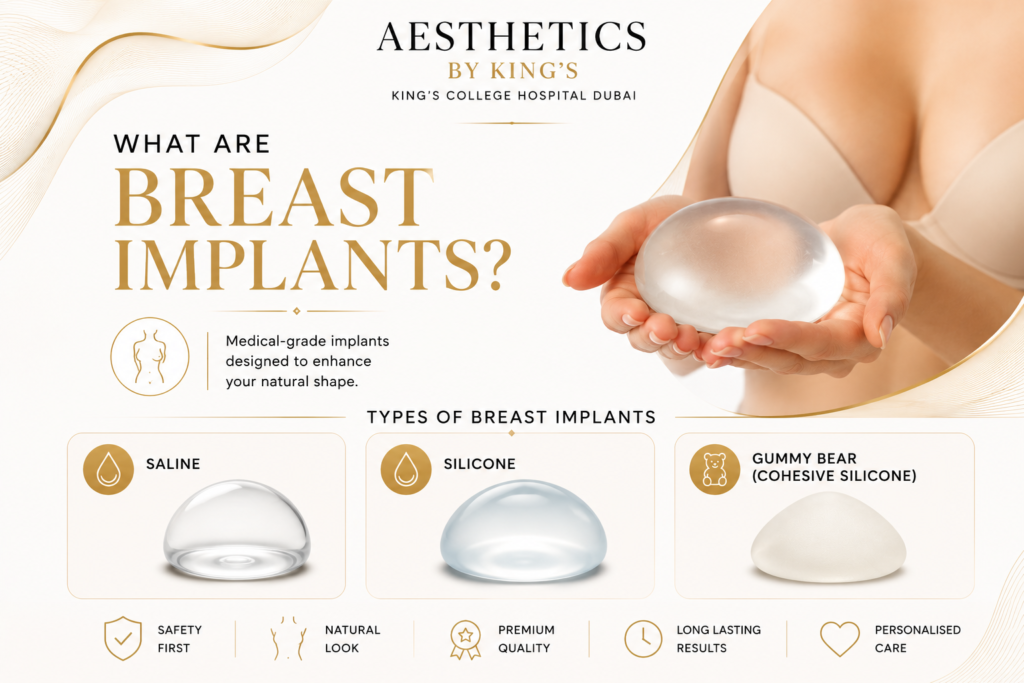
What are Breast Implants?
Breast implants are medical-grade devices positioned under the breast tissue or chest muscle to increase volume, improve symmetry, or help restore shape that’s changed following weight loss or surgery. According to data from the International Society of Aesthetic Plastic Surgery, breast augmentation consistently ranks among the top three cosmetic surgical procedures performed worldwide each year.
Choosing between implant types for breast augmentation involves more than just picking a size. Your surgeon will factor in your body frame, skin elasticity, existing breast tissue, and of course, what you’re actually hoping the results will look like.
Why Breast Augmentation remains one of the most popular cosmetic procedures?
Breast augmentation is cosmetic breast surgery that consistently ranks among the top cosmetic surgical procedures performed worldwide.
People choose it for all kinds of reasons:
- Restoring volume after pregnancy or weight loss
- Correcting natural asymmetry
- Rebuilding confidence after life changes
- Achieving a more proportionate figure
Whatever your reason, understanding the breast implant types available puts you in a far stronger position before any surgeon conversation.
Breast Implant Types Explained:
Saline vs Silicone – The core decision
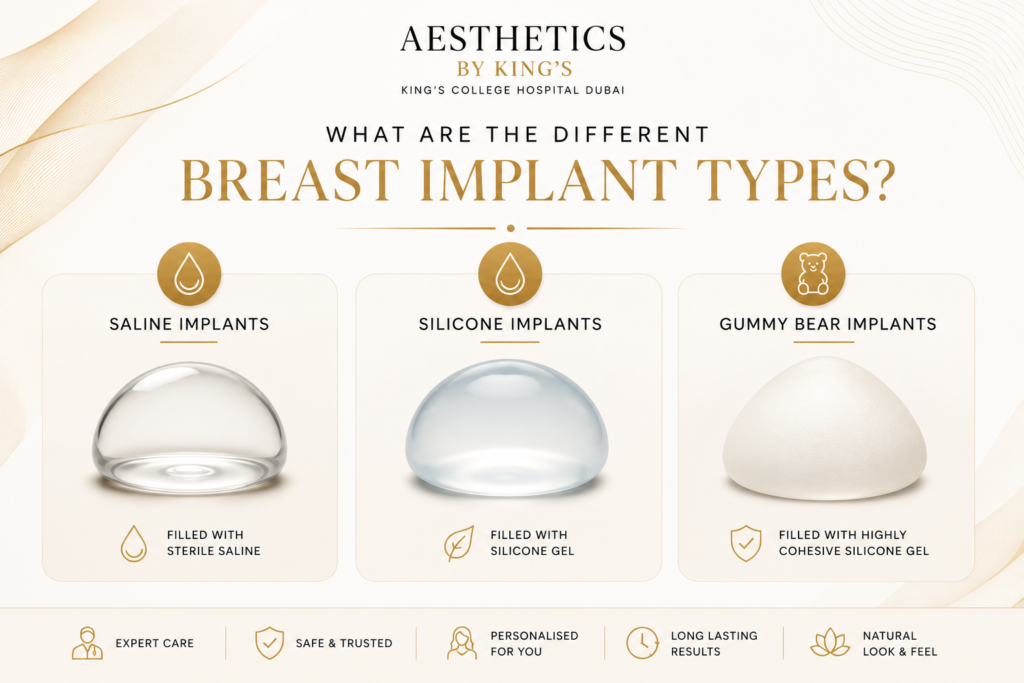
The first choice in breast augmentation is almost always the implant material. Both silicone and saline breast implants are clinically approved and widely used, but they suit different patients for different reasons.
Silicone Breast Implants
Silicone breast implants arrive pre-filled with a cohesive gel that closely resembles the feel of natural breast tissue.
Best for: Patients with less natural breast tissue who need better coverage and a softer feel.
Key points:
- Pre-filled, so there’s no adjusting volume during surgery
- Rippling under the skin is less of a concern
- In the event of a rupture, the gel tends to stay contained, which is why it’s called a “silent rupture”
- MRI scans may be recommended from time to time to monitor them
Saline Breast Implants
Saline implants are put in empty and filled with sterile salt water during the procedure, which means they offer a level of adjustability that silicone doesn’t really have.
Best for: Patients who want volume flexibility and straightforward rupture detection.
Key points:
- Inserted through a smaller incision
- Volume adjusted on the operating table
- If ruptured, saline is safely absorbed by the body, and the change is immediately visible
- May feel slightly firmer than silicone
Quick comparison: Breast implant types, saline vs silicone
Feature | Silicone | Saline |
Feel | Soft, natural | Slightly firmer |
Rupture detection | Silent, imaging needed | Immediately visible |
Incision size | Slightly larger | Smaller |
Volume adjustability | No | Yes |
Best for | Less natural tissue | Adequate tissue coverage |
Gummy Bear Implants: Form-stable silicone explained
Among silicone breast implant types, gummy bear implants are in a category of their own. These are form-stable devices, meaning they hold their shape even if the shell is compromised, just like the sweet they’re named after.
Why patients choose them?
- Retain their contour reliably over time
- Deliver highly natural-looking breast augmentation results
- Less upper pole fullness, more of a gradual, anatomical slope
- Among the longest-lasting breast implants available
They’re almost always teardrop-shaped and use a thicker cohesive gel than standard silicone.
Breast Implant Shapes: Round vs Teardrop Implants
Shape is one of the most visible factors in your result. There are two main breast implant shapes, round and teardrop, and each has a very different aesthetic purpose.
Round Breast Implants
- Symmetrical, identical fullness top and bottom
- No rotation risk; any movement doesn’t affect appearance
- Create visible upper pole fullness and defined cleavage
- Available in silicone or saline
Teardrop Breast Implants (Anatomical)
- Fuller at the base, tapering toward the top
- Closely mimic the natural breast contour
- Require a textured surface to prevent rotation
- Popular for reconstruction patients and those wanting subtle results
Round vs Teardrop: Side-by-side
Feature | Round | Teardrop |
Upper pole fullness | Pronounced | Subtle |
Natural slope | Moderate | High |
Rotation risk | None | Yes, needs textured shell |
Surface type | Smooth or textured | Typically textured |
Best result for | Defined cleavage | Natural, proportionate look |
Smooth vs Textured Implants: What you need to know?
The outer shell of the implant matters both clinically and in terms of feel.
Smooth implants:
- Move naturally within the breast pocket
- Softer feel overall
Textured implants:
- Designed to grip surrounding tissue and limit movement
- Originally developed to reduce capsular contracture risk
- Macro-textured varieties have been linked to BIA-ALCL, a rare immune system condition
- Micro-textured surfaces (such as Motiva’s SilkSurface) carry a significantly lower risk profile
Types of breast implant incisions
Where your incision is placed determines where your scar will be. Here are the main types of breast implant incisions used today:
Inframammary – A fine cut in the fold beneath the breast. The most commonly used approach. Scar sits in the natural crease and fades well over time.
Periareolar – It is present around the lower edge of the areola. Scar blends with the skin’s colour change but may slightly affect nipple sensation.
Transaxillary – In the armpit. No scar on the breast itself, but it is more technically demanding. Better suited to saline implants.
TUBA (transumbilical) – Through the navel. Rarely performed ; not suitable for silicone implants.
For most patients, the inframammary incision produces the most discreet types of breast implant scars, with significant fading over 12–18 months.
Types of breast implant placement
Implant placement techniques refer to where the implant sits in relation to your chest muscle. This affects appearance, recovery, and long-term outcomes.
Subglandular (over the muscle)
- Sits behind breast tissue, in front of the pectoral muscle
- Quicker recovery, less discomfort
- Implant may be more visible in patients with limited tissue
Submuscular (under the muscle)
- Placed beneath the pectoral muscle
- Better natural coverage, particularly at the top
- Longer recovery; initial chest tightness is common
Dual plane (most commonly recommended)
- Upper portion under the muscle; lower portion over it
- Best of both, natural coverage with good lower pole shape
- The most widely used implant placement technique today
Breast Implant sizes and profile types
Implant volume is measured in cubic centimetres (cc), not bra cup sizes, which vary considerably between brands. The same cc can look quite different depending on your frame.
Profile types – how far the implant projects:
Profile | Base width | Projection | Best suited for |
Low | Wide | Subtle | Broader frames |
Moderate | Balanced | Medium | Most body types |
High | Narrow | More forward | Narrower frames |
Matching breast implant sizes and types to your chest measurements is one of the most important parts of your consultation. 3D imaging or physical sizers help you visualise results before making any decision.
Mentor vs Motiva Implants: Key differences
These are the modern breast implants techniques. Two of the most trusted breast implant brands available are Mentor and Motiva. Here’s how they compare:
Mentor implants
- Over 30 years of clinical data
- Available in silicone and saline, round and anatomical
- MemoryGel range well-regarded for natural feel
- Widely used in both NHS and private practice
Motiva implants
- Next-generation implants built with advanced engineering
- SilkSurface micro-textured shell designed for a lower complication profile
- TrueMonobloc design brings the gel, shell, and port together as one unit
- Well-suited to patients looking for long-lasting implants with minimal risk
Neither is universally superior. Your surgeon will recommend the right brand based on your anatomy, goals, and clinical history.
Different types of breast implant procedures: What surgery involves?
Breast augmentation is performed under general anaesthesia and typically takes one to two hours. Here’s what the procedure involves:
- Pre-operative assessment and markings
- Anaesthesia administered
- Incision made at the agreed site
- Pocket created, over or under the muscle
- Implant inserted and positioned
- Symmetry checked
- Incision closed with sutures
- Dressings applied; patient moved to recovery
Most patients go home the same day.
Breast implant recovery timeline
Timeframe | What to expect |
Days 1–3 | Rest, swelling, mild discomfort |
Week 1–2 | Light activity; no driving |
Week 3–4 | Most daily tasks manageable |
Week 4–6 | Gradual return to exercise |
Month 3–6 | Final results visible |
Breast implant recovery timeline
Breast implant recovery timeline:
Timeframe | What to expect |
Days 1–3 | Rest, swelling, mild discomfort |
Week 1–2 | Light activity; no driving |
Week 3–4 | Most daily tasks manageable |
Week 4–6 | Gradual return to exercise |
Month 3–6 | Final results visible |
Breast Implant Illness (BII): What patients should know?
Breast implant illness is a term used to describe a range of systemic symptoms, fatigue, joint pain, brain fog, skin issues, that some women report after receiving implants.
Important points:
- Not yet a formally classified medical diagnosis
- Taken seriously by surgeons and researchers
- Some patients report improvement after explantation (implant removal)
- Symptoms vary widely between individuals
Don’t ignore unexplained changes after breast augmentation surgery, raise them with your surgeon as soon as you can. Open communication throughout your journey is absolutely essential.
Breast implant benefits and risks: An honest overview
Benefits
- Shape and volume improvements that last
- Highly customisable to your individual anatomy
- Approved materials with a strong and well-established safety record
- Wide range of outcomes that look and feel natural
Risks
- Capsular contracture, where scar tissue around the implant hardens
- Rupture or leakage of the implant
- Changes in sensation around the nipple or breast
- Rippling or the implant being felt through the skin
- Revision surgery may be needed at some point
- BIA-ALCL associated with macro-textured implants (rare)
- Some patients report breast implant illness
How to choose the right breast implants for you?
There’s no one-size-fits-all answer when it comes to implant types for breast augmentation. Before your breast implant surgery consultation, consider:
- Do you want a natural result or more visible fullness?
- How much natural breast tissue do you currently have?
- Is scar placement a priority for you?
- Are you comfortable with a longer recovery for better coverage?
- What are your expectations long-term?
The safest breast implant type is always the one chosen carefully, based on your anatomy, goals, and a thorough conversation with an experienced surgeon.
What to expect at your breast implant surgery consultation?
At Aesthetics by King’s, every consultation covers:
- Full medical history review
- Physical measurements of chest width and tissue quality
- Discussion of all breast implant options, materials, shape, size, surface, and placement
- Recovery planning and aftercare guidance
You should leave feeling informed, not overwhelmed.
Understanding breast implant types is your first step
Choosing breast augmentation from various breast augmentation options available is a personal decision, and it deserves a thorough, personalised approach. Understanding the different breast implant types available, from silicone vs saline implants to round vs teardrop shapes, smooth vs textured surfaces, and the various types of breast implant surgery and types of breast implant placement and incisions, means you’re already better prepared than most patients walking into their first appointment.
Whether you’re looking for the natural contour of gummy bear implants, the versatility of round silicone breast implants, or a subtle anatomical result, there is an option that fits your body and your goals.
At Aesthetics by King’s, our team is here to guide you through every decision, clearly, honestly, and without pressure.
Book your consultation today and take the first step with confidence.
FAQs
Silicone, saline, and form-stable (gummy bear) implants are the three main types. They come in round or teardrop shapes, smooth or micro-textured surfaces, and a range of sizes and profiles to choose from.
Silicone works better for patients with less tissue and feels more natural, while saline makes volume adjustment and rupture detection more straightforward. It really comes down to your body and what matters most to you.
Gummy bear implants use a thicker cohesive gel that stays put even if the shell is compromised, they’re form-stable, built to last, and a popular choice for anyone after natural-looking results.
For even fullness and well-defined cleavage, round implants are a popular choice. Teardrop implants mirror the natural breast slope and suit patients wanting subtle, anatomical results.
Most patients are left with a fine line in the inframammary fold, which fades over 12 to 18 months. A periareolar incision leaves a subtle scar at the edge of the areola. The best incision type most of the time depends on your implant choice and anatomy.
Subglandular (over the muscle), submuscular (under the muscle), and dual plane are the three main placement options and dual plane has become the most commonly used technique.
Breast implant illness refers to systemic symptoms, including fatigue, brain fog, and joint pain, reported by some women with implants. It is not yet formally classified as a diagnosis, but is taken seriously clinically. Any unexplained symptoms should be discussed with your surgeon.
Mentor implants have over 30 years of clinical use and are widely trusted. Motiva implants are a newer generation with a micro-textured SilkSurface shell and a strong, long-term safety profile. Both are available at Aesthetics by King’s.
Implant size is measured in cc, not bra cup sizes. During your consultation, sizers or 3D imaging help you visualise results. Matching breast implant sizes and types to your chest width and tissue is key to a proportionate outcome.
Yes. With the right implant type, shape, profile, and placement, highly natural-looking results are achievable. Teardrop and gummy bear implants are designed specifically for this outcome.
A full consultation covers your medical history, measurements, a detailed discussion of all implant types for breast augmentation, incision and placement options, risks, and recovery. You’ll have plenty of time to ask questions before any decision is made.